
When technology giants look at Southeast Asia, Indonesia is the ultimate prize. With over 275 million digitally active citizens, an exploding fintech scene, and a government aggressively pushing for a national AI strategy, the archipelago is prime real estate for the next digital gold rush.
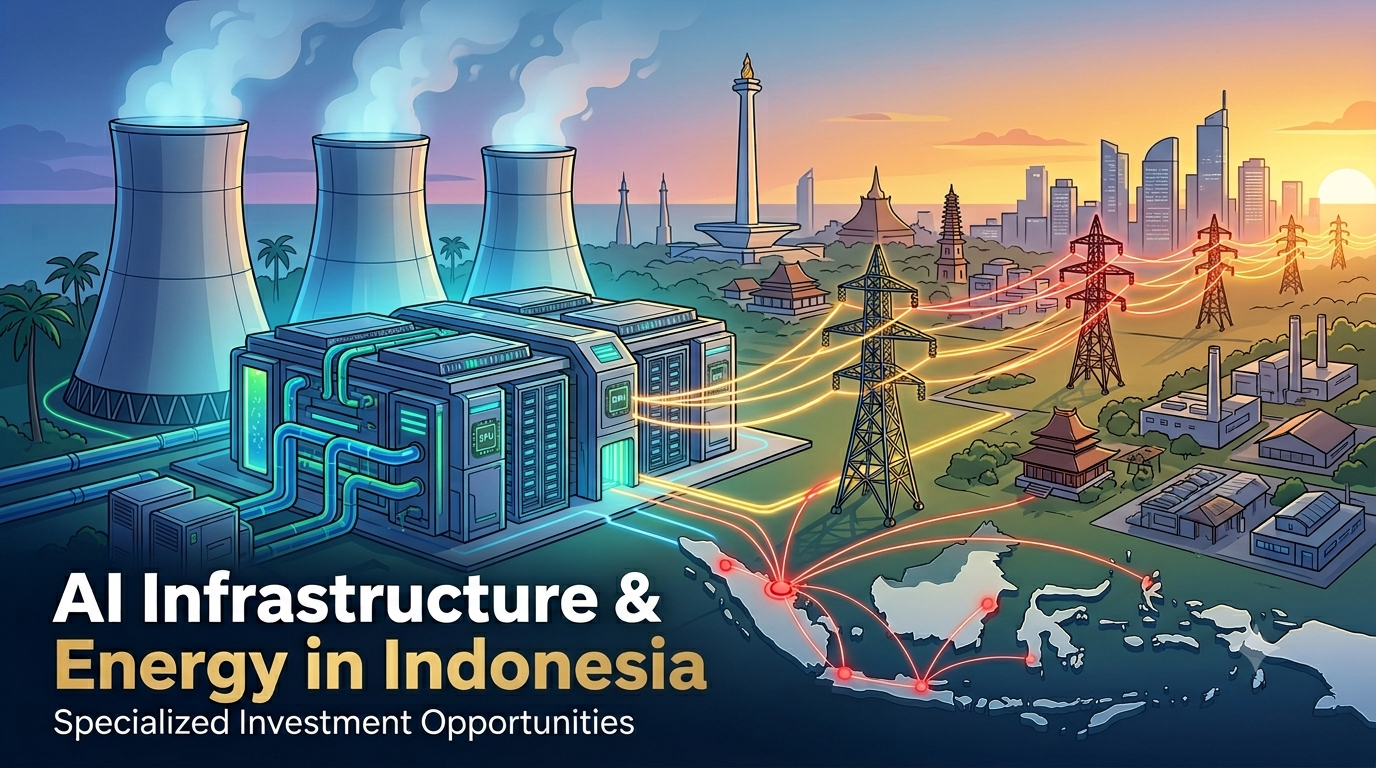
But behind the high-level talk of AI sovereignty and digital transformation lies a physical, hard-engineering truth: AI is a power-hungry beast, and Indonesia’s electrical grid is running out of runway.
As we move through 2026, the intersection of AI infrastructure and the Indonesian energy matrix has created a high-stakes bottleneck—and one of the most asymmetric investment opportunities in emerging markets.
The AI Heat Wave Hits Greater Jakarta
Historically, data centers were glorified digital filing cabinets. They stored your e-commerce history and backed up enterprise databases, consuming a steady, predictable amount of electricity.
AI completely breaks this model. Training large language models and running complex neural networks requires high-performance Graphics Processing Units (GPUs). A standard conventional data center rack pulls about 4 to 8 kilowatts (kW) of power. An AI-ready rack packed with Nvidia H100s or B200s can easily demand 30 to 100+ kW per rack.
This surge in power density creates two massive operational problems in a tropical climate like Indonesia:
-
The Cooling Penalty: Jakarta is hot and humid. Traditional air-cooling systems struggle under the immense heat generated by AI workloads. This ruins the facility’s Power Usage Effectiveness (PUE)—a metric where 1.0 is perfect. While global modern standards chase a PUE of 1.1, many Indonesian facilities still lag in the 1.2 to 1.6 range because they are burning massive amounts of extra electricity just to keep the servers from melting.
-
The Grid Crunch: In places like the industrial heartland of West Java and the Greater Jakarta area, hyperscale data center clusters are aggressively drawing down grid capacity, competing directly with local manufacturing and local communities.
The Coal Dilemma vs. The Renewable Mandate
Indonesia finds itself caught in a structural paradox.
To attract mega-investments from global players like Microsoft, Oracle (which partnered with the government for a massive GPU cluster launch), and regional builders like SMPlus (constructing the 60MW SMX01 AI-ready center in Jakarta), the country must provide 24/7, ultra-reliable baseload power.
Right now, the cheapest and most reliable way Indonesia does that is through coal.
However, tech conglomerates operate under strict net-zero mandates. They cannot power their AI clusters with carbon-heavy grids without facing severe backlash and regulatory penalties back home. While local players like EDGE DC utilize Renewable Energy Certificates (RECs) from state utility PLN to leverage geothermal energy, the broader reality is that Indonesia’s clean energy infrastructure is struggling to scale fast enough to meet the 15%+ annual compounded growth rate of data center power demand.
3 Emerging Niche Plays for Investors
For investors looking to capitalize on this bottleneck, the money isn’t in the AI software itself; it’s in the physical enablers solving the energy crisis.
1. B2B Liquid Cooling & Infrastructure Retrofits
Because air cooling is failing in tropical AI environments, the market is pivoting aggressively toward Direct-to-Chip Liquid Cooling and Immersion Cooling. Companies providing specialized industrial heat exchangers, fluid mechanics, and modular data center infrastructure to the Indonesian market are experiencing a massive surge in demand.
2. The Batam-Singapore Clean Energy Interconnectors
Singapore famously capped its own data center growth due to land and power constraints, shifting its demand directly to Indonesia’s Nongsa Digital Park in Batam. This has turned Batam into a hyper-growth zone. The real play here lies in companies building cross-border subsea cables and regional microgrids (like the Brunei-Indonesia-Malaysia-Philippines Power Integration Project) that can feed green energy directly to these border clusters.
3. The Archipelago Nuclear Blueprint (Looking to 2030+)
The Indonesian government’s recent Electricity Supply Business Plan (RUPTL) outlines a bold pivot: introducing Small Modular Reactors (SMRs) and Floating Nuclear Power Plants (FNPPs) into the national grid framework by the early 2030s to supply 24/7 carbon-free power. Companies specializing in nuclear supply chains, marine engineering for floating power plants, and localized micro-fission tech are positioning themselves early for this multi-billion-dollar shift.
The Bottom Line
Indonesia’s AI revolution cannot happen in the cloud; it has to happen on the ground, inside the substations, and through the power lines.
The operators who figure out how to scale high-density, liquid-cooled, AI-ready data centers—and the energy providers who can supply them with reliable, low-carbon baseload power—will own the digital foundation of Southeast Asia’s largest economy.
As recent reports by Physics Cyber & Industry news Australia, the demand in energy for AI will double within 2 years in Indonesia.