

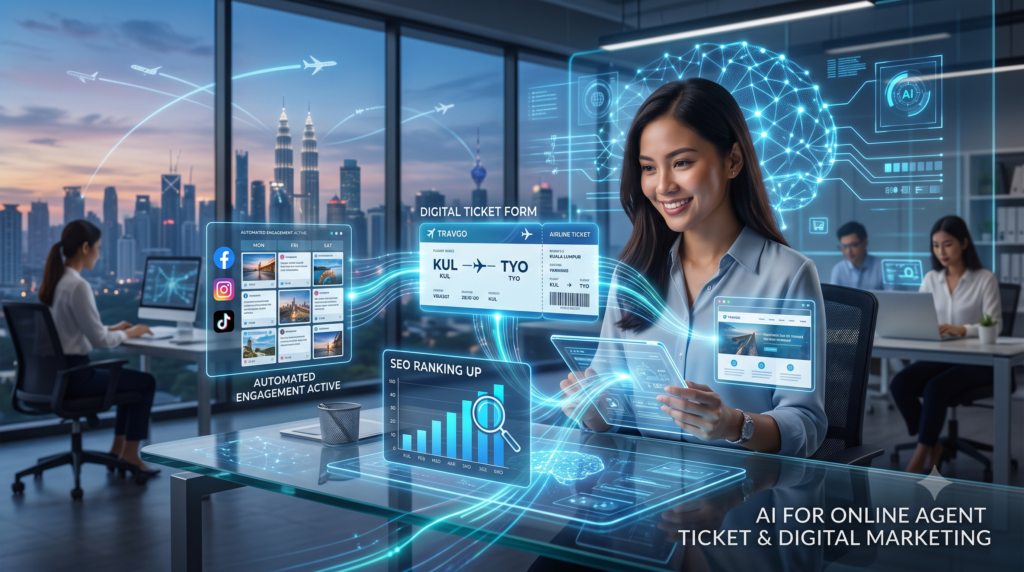
Selling flight and travel tickets online is a fast-paced business. Decades ago, customers had to walk into a physical store to book a flight or plan a vacation. Today, they expect to find the best deals directly on their mobile phones. For a modern travel entrepreneur, standing out in this crowded space requires a very strong online presence. This means having a fast website, a high ranking on search engines, and an active social media profile. Managing all of these channels manually used to be overwhelming. Now, the integration of AI for online agent ticket platforms is making it much easier for independent travel agents to compete with massive travel corporations.
Instead of hiring large marketing teams, modern ticket agents are using smart software to handle the heavy lifting. This shift is giving ordinary people the chance to run successful travel businesses from their living rooms or small offices. By tapping into digital marketing services powered by machine learning, ticketing agents can build better websites, run smarter search campaigns, and keep their social media accounts active around the clock without burning out.
Smarter Website Creation for Travel Businesses
When a customer visits a travel website, they want to find their destination, see the price, and book the flight within a few minutes. If the website is slow, looks outdated, or has a confusing layout, the customer will immediately leave and go to a competitor. This is where AI for online agent ticket usage placed.
Designing for Speed, Trust, and Conversions
In the past, developing a custom booking site required hiring an expensive web developer and waiting several months for the final product to be tested and launched. Now, smart web building tools can generate a professional, mobile-friendly site almost instantly. These systems analyze what visual layouts work best in the travel industry and automatically apply those specific design rules to the new site. They ensure the colors, buttons, and booking forms are placed exactly where users expect them to be.
For instance, modern travel reservation networks like TravGO allow people to start their own travel agency without dealing with complicated technical setups. By providing a ready-to-use digital infrastructure, agents do not have to worry about coding a reservation system from scratch. They get a reliable dashboard where they can instantly search for flights, compare prices, and issue e-tickets. AI for online agent ticket tools take this a step further by optimizing the agent’s promotional landing pages, ensuring that the site always loads quickly and looks highly secure to the buyer, which is critical when handling payment information.
Upgrading SEO Services to Capture High-Intent Travelers
Having a great website means nothing if no one can find it on search engines. Search Engine Optimization (SEO) is the backbone of any online business that wants long-term, free traffic.
Moving Beyond Basic Keyword Guessing
In the early days of the internet, you could just repeat the words “cheap flights” fifty times on a page and rank at the top of Google. Today, search algorithms are incredibly smart. They want to show users the most helpful and relevant information available. Using AI for digital marketing allows a ticket agent to understand exactly what their potential customers are typing into the search bar. Instead of guessing what to write, the software provides a clear map of current search trends.
The data might reveal that families are currently searching for “affordable group flights to Bali in December” rather than just looking for general “Bali tickets.” With this detailed information, tools of AI for online agent ticket can write specific, helpful blog posts answering those exact queries. The software also helps structure the articles perfectly, suggesting the best places to put internal links and ensuring the content actually answers the traveler’s questions completely. This strategy builds authority and helps the agent’s website slowly climb to the top of the search results.
Automating Social Media Services for Travel Brands
Travel is an emotional purchase. People buy tickets because they want to go on a holiday, visit their family, or close an important business deal. Social media is the best place to tap into those emotions.
Keeping Passengers Engaged Around the Clock
To attract buyers, travel agents need to constantly share beautiful photos of destinations, highlight limited-time flight discounts, and share travel tips. However, running a Facebook, Instagram, or TikTok page takes a lot of daily effort. Creating graphics, writing captions, and replying to comments can easily consume an agent’s entire workday, leaving them with no time to actually process ticket sales.
Smart marketing tools step in to act as a virtual social media manager. An online ticket agent can use these programs to schedule an entire month of promotional posts in just one afternoon. The system can even look at historical data to determine the exact time of day when followers are most likely to book a ticket and schedule the post for that specific minute. Furthermore, if a customer sends a direct message asking about baggage allowances at 2:00 AM, an intelligent chatbot can provide an instant, accurate answer. This keeps the customer happy and prevents the agent from losing a potential sale while they are asleep.
Economic Growth and Cross-Industry Efficiency
The push toward smart marketing and automated business operations is not just happening in the travel sector alone. Across Southeast Asia, embracing digital technology is becoming a primary driver for massive economic expansion.
Learning from Regional and Industrial Upgrades
When local travel agencies adopt these advanced digital marketing tools, they contribute to a much larger wave of regional growth. We see this reflected in broader economic discussions, such as the reports detailing the navigasi ekonomi Malaysia 2026 tumbuh targets. These projections clearly show that digital adaptation is heavily pushing financial progress across all service industries in the region. Businesses that learn to use software to serve customers faster naturally generate more revenue.
The underlying principle of using software to reduce manual labor applies everywhere. Consider how AI changes construction sector logistics by accurately predicting material needs and cutting down on physical waste. The travel industry uses the exact same logic. By predicting where people want to travel and automating the advertising process, ticket agents reduce their wasted marketing budget and maximize their daily sales. Whether an industry is moving heavy steel beams or booking digital flight tickets, the overarching goal is always to work smarter, lower operational costs, and serve the client better.
Comparing Traditional Marketing to Modern Systems
To easily understand how much the digital marketing landscape has improved for travel agents, here is a direct comparison of the old methods versus the new software-assisted approach.
| Marketing Service | Traditional Ticket Agency Approach | AI-Assisted Ticket Agency Approach |
| Website Design | Expensive custom coding taking months to launch | Instant templates optimized specifically for travel booking |
| SEO Strategy | Guessing keywords and manually checking competitors | Predictive search data and automated content structure outlines |
| Social Media | Manual daily posting and delayed customer replies | Automated bulk scheduling and 24/7 intelligent chatbot support |
| Customer Targeting | Generic print ads shown to a broad, random audience | Highly specific digital ads shown to users actively planning trips |
| Market Research | Reading through slow, outdated industry reports | Real-time tracking of flight demand and travel destination trends |
Frequently Asked Questions (FAQ)
1. How does smart software help a brand-new online ticket agent?
It helps by automating the hardest and most time-consuming parts of digital marketing. A beginner can use these tools to quickly build a professional website and schedule promotional posts on social media.
2. Do business owner need to know how to code to use these digital marketing tools?
Not at all. Most modern software platforms are built specifically for business owners with zero technical background. They use simple visual interfaces or ask you a few basic questions before generating the website layout, SEO keywords, or social media captions for you.
3. Will automated customer service make travel agency look unprofessional?
It will only look unprofessional if it is set up poorly. A well-designed chatbot provides immediate, helpful answers to common questions like “What is my cabin baggage limit?” or “How do I check in online?”. If the bot cannot answer a complex question, it simply forwards the message to you so you can handle it personally.
4. Why is SEO still important for selling flight tickets online?
Because most travelers start their booking journey by typing a question into a search engine. If your website shows up on the first page when someone searches for “best travel agent in my city,” you get free, high-quality traffic. Good SEO ensures your business is visible to people who have their credit cards out and are ready to buy.
5. Can these tools help competing with large travel corporations?
Yes. Large companies spend millions on broad advertising, but smart software allows independent agents to target highly specific niche markets. By finding low-competition keywords and running highly targeted local ads, a solo agent can secure loyal customers without needing a massive corporate marketing budget.