

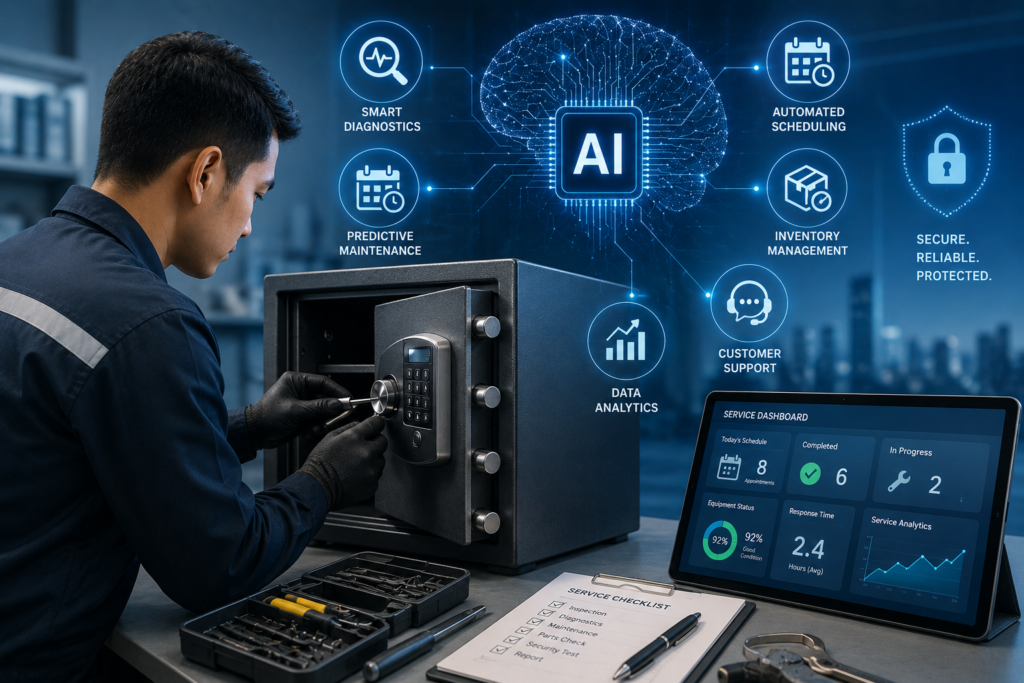
Security equipment has become increasingly sophisticated over the years. Modern safes are no longer just heavy steel boxes with mechanical locks. Many now feature electronic keypads, biometric authentication, digital locking systems, audit trails, and remote management capabilities. While these innovations improve security, they also make maintenance and repair more complex. For companies specializing in safe repair and maintenance, keeping up with evolving technology requires more than technical expertise. Service providers need accurate diagnostics, efficient scheduling, organized maintenance records, and faster response times to meet customer expectations. This is where future AI for service’s role.
Artificial intelligence is beginning to play an important role in this transformation. Rather than replacing experienced technicians, AI helps businesses analyze operational data, automate administrative tasks, and improve maintenance planning. The result is a more efficient service process while preserving the technical knowledge that remains essential for handling security equipment. The future AI for service is not about replacing people with machines. Instead, it focuses on giving technicians better information, helping businesses respond more quickly, and creating a smoother experience for customers who depend on reliable safe maintenance services.
Why AI Is Becoming Valuable for Service Businesses
Service companies often manage multiple customer requests every day. They coordinate technician schedules, maintain service histories, monitor spare parts inventory, prepare quotations, and respond to emergency repair calls. When these activities rely entirely on manual administration, delays and communication errors become more likely.
Artificial intelligence helps organize operational data while supporting faster decision-making. Instead of searching through paper records or spreadsheets, businesses can instantly access maintenance histories, previous repairs, warranty information, and technician availability. For companies providing safe repair services, this improves both operational efficiency and customer satisfaction.
Smarter Maintenance Through Predictive Diagnostics
Preventing Problems Before Equipment Fails
Traditional maintenance usually begins after customers notice that something is wrong.
A safe may become difficult to unlock, electronic components may malfunction, or locking mechanisms may stop operating properly.
With AI-supported diagnostics, businesses can move toward preventive maintenance rather than reactive repairs.
By analyzing maintenance histories, component lifespan, environmental conditions, and previous service records, AI can estimate when certain parts are likely to require inspection or replacement.
This proactive approach helps customers reduce unexpected breakdowns while extending the lifespan of valuable security equipment.
Faster Technical Diagnosis
Diagnosing a safe malfunction often requires technicians to evaluate multiple possible causes.
Artificial intelligence can support this process by comparing reported symptoms with historical repair data.
Instead of beginning every inspection from scratch, technicians receive possible diagnostic recommendations before arriving on-site.
Although experienced professionals still perform the final inspection, AI reduces troubleshooting time and improves repair efficiency.
Better Service Scheduling
Managing technician schedules becomes increasingly challenging as customer demand grows.
Emergency repairs, preventive maintenance, travel time, and equipment availability all influence scheduling decisions.
AI scheduling systems evaluate:
- Customer location
- Technician expertise
- Service urgency
- Estimated repair duration
- Spare part availability
- Daily workload
Based on this information, the system recommends schedules that minimize travel time while maximizing technician productivity.
Customers also benefit from more accurate appointment estimates.
Improving Customer Service
Fast communication is one of the biggest factors influencing customer satisfaction.
Many customers simply want quick answers regarding:
- Service availability
- Maintenance schedules
- Repair status
- Warranty coverage
- Service pricing
- Appointment confirmation
AI-powered customer support tools can respond to routine inquiries at any time, allowing administrative staff to focus on requests that require personal attention.
This shortens response times while maintaining professional service quality.
Smarter Spare Parts Management
Maintaining the right inventory of replacement parts is essential for service companies.
Insufficient inventory delays repairs, while excessive stock increases storage costs.
AI continuously analyzes:
| Inventory Function | AI Benefit |
|---|---|
| Spare parts demand | Predicts future usage patterns |
| Inventory levels | Recommends optimal stock quantities |
| Supplier performance | Tracks delivery reliability |
| Purchasing schedules | Helps avoid emergency purchases |
| Product lifespan | Estimates replacement frequency |
| Warehouse management | Improves inventory organization |
Better inventory planning allows technicians to complete repairs more efficiently while reducing operational expenses.
Data Helps Improve Business Decisions
Artificial intelligence is particularly valuable because it transforms routine service records into meaningful business insights.
Service companies can evaluate:
- Most common repair types
- Equipment failure trends
- Technician productivity
- Customer response times
- Repeat maintenance requests
- Spare parts consumption
- Regional service demand
These insights help managers improve resource allocation while planning future business growth.
Practical Applications for Safe Repair Companies
Businesses do not need to adopt every AI solution immediately.
A company such as Jasa Service Brankas can begin with digital maintenance records and AI-assisted scheduling before expanding into predictive diagnostics, inventory forecasting, or customer support automation.
This gradual implementation reduces operational risks while allowing employees to adapt to new technologies.
As cloud-based AI platforms become more affordable, intelligent maintenance systems are becoming increasingly accessible for specialized service providers.
AI Supports Many Industries Beyond Equipment Maintenance
Artificial intelligence is improving operational efficiency across a wide range of industries.
Businesses adopting AI in cold storage logistics use predictive monitoring, automated reporting, and real-time tracking to maintain product quality throughout temperature-controlled supply chains.
Similarly, companies implementing AI use in restaurant solutions improve inventory management, staffing schedules, customer service, and purchasing decisions through predictive analytics.
Corporate planning is also evolving. The growing interest in future AI event organizer technologies demonstrates how intelligent systems simplify scheduling, supplier coordination, and attendee management while allowing organizers to focus on delivering high-quality experiences.
Although these industries operate in different sectors, they all demonstrate how AI supports better planning, faster decision-making, and more efficient daily operations.
Staff Training Encourages Successful Adoption
Introducing AI requires employees to understand how digital tools support daily operations.
Providing practical training helps technicians and administrative staff use AI effectively while continuing to rely on their professional judgment.
The most successful organizations combine intelligent technology with experienced personnel.
The Future of AI for Safe Repair Services
Artificial intelligence is expected to become increasingly common across technical service industries.
Future developments may include:
- Predictive equipment maintenance
- AI-assisted fault detection
- Automated appointment scheduling
- Smart spare parts forecasting
- Digital maintenance records
- Remote equipment monitoring
- Intelligent technician dispatching
Rather than changing the role of service technicians, these innovations will improve operational efficiency while allowing professionals to spend more time solving technical problems and assisting customers.
Conclusion
The future AI for service represents an important step forward for businesses providing safe repair and maintenance services. By improving diagnostics, scheduling, inventory management, preventive maintenance, and customer communication, AI enables companies to operate more efficiently while maintaining high service standards.
For specialized businesses, success will continue to depend on skilled technicians, trusted customer relationships, and reliable service. Artificial intelligence simply provides better tools to support those strengths. Companies that combine technical expertise with intelligent digital solutions will be better prepared to meet future customer expectations in an increasingly technology-driven market.
Frequently Asked Questions (FAQ)
What is future AI for service?
Future AI for service refers to the use of artificial intelligence to improve maintenance operations, diagnostics, scheduling, customer support, and business decision-making for service companies.
How does AI help safe repair businesses?
AI supports predictive maintenance, technician scheduling, inventory management, service history analysis, and customer communication, making repair operations more efficient.
Can AI replace safe repair technicians?
No. AI provides recommendations and operational insights, but experienced technicians remain responsible for inspections, repairs, and ensuring equipment functions safely.
Why is predictive maintenance important?
Predictive maintenance helps identify potential equipment issues before failures occur, reducing downtime, repair costs, and unexpected service interruptions.
Is AI suitable for small service businesses?
Yes. Many AI-powered service management platforms are cloud-based and scalable, making them practical for both small and large maintenance companies.