
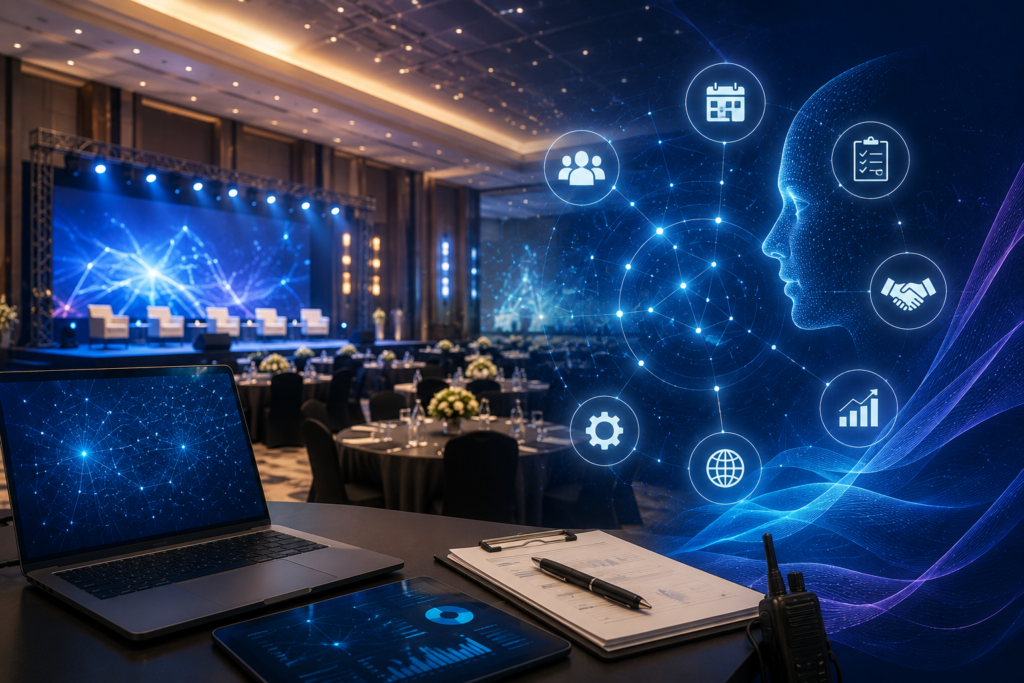
The corporate events industry has changed significantly over the past decade. Businesses no longer organize conferences, product launches, annual meetings, or employee gatherings simply to fill an agenda. Every event is expected to strengthen relationships, reinforce brand identity, and deliver measurable business outcomes. At the same time, organizing corporate events has become increasingly complex. Event planners coordinate multiple suppliers, manage budgets, communicate with vendors, monitor schedules, handle registrations, and ensure every detail runs according to plan. Even a minor oversight can affect the overall experience.
This growing complexity has encouraged many event organizers to adopt digital solutions, and artificial intelligence has become one of the most promising technologies available. Rather than replacing event professionals, AI helps simplify administrative tasks, improve planning accuracy, and provide insights that support better decision-making. A future AI event organizer supplier model represents the next stage of corporate event management. AI-powered systems enable organizers to work more efficiently while maintaining the creativity and personal attention that successful events require. This article explores how AI is reshaping corporate event planning, the practical benefits it offers, and why businesses should consider integrating AI into their event management strategies.
Why AI Is Becoming Essential for Corporate Event Planning
Corporate events involve hundreds of moving parts.
Planning typically includes venue selection, supplier coordination, catering, transportation, accommodation, audiovisual equipment, registration management, budgeting, and post-event evaluation.
Managing all of these activities manually becomes increasingly difficult as event size grows.
Artificial intelligence helps organize large volumes of operational data while identifying patterns that support faster planning decisions.
Instead of spending hours reviewing spreadsheets or tracking supplier updates, event teams receive real-time information that helps them respond quickly whenever adjustments are needed.
For companies organizing multiple events throughout the year, AI provides consistency while reducing repetitive administrative work.
AI Simplifies Event Planning From Start to Finish
Smarter Project Scheduling
Creating an event timeline requires careful coordination between multiple stakeholders.
AI-powered project management tools automatically organize task schedules, identify overlapping activities, and notify teams when deadlines are approaching.
Instead of manually updating project timelines, organizers can monitor progress through real-time dashboards that reflect current project status.
This improves collaboration between internal teams and external suppliers.
Better Budget Management
Budget control remains one of the biggest challenges in corporate event planning.
Unexpected supplier costs or last-minute changes often increase total event expenses.
AI systems analyze historical budgets alongside current market pricing to estimate realistic project costs.
They can also identify spending trends that help planners avoid unnecessary expenses while allocating resources more efficiently.
Rather than reacting after costs increase, organizers gain better financial visibility throughout the planning process.
AI Helps Select the Right Suppliers
Corporate events rely heavily on dependable vendors.
Choosing suppliers based only on previous experience may overlook valuable opportunities or hidden risks.
AI evaluates supplier performance using measurable criteria such as:
| Supplier Evaluation Area | AI Contribution |
|---|---|
| Delivery performance | Tracks punctuality and reliability |
| Pricing consistency | Compares historical quotations |
| Service quality | Reviews previous performance records |
| Contract fulfillment | Measures completed projects |
| Response time | Monitors communication efficiency |
| Risk assessment | Identifies potential operational issues |
This data-driven approach supports more informed procurement decisions while strengthening long-term supplier partnerships.
Personalized Attendee Experiences
Modern corporate events increasingly focus on creating meaningful participant experiences.
Artificial intelligence helps organizers personalize communication before, during, and after the event.
AI can recommend:
- Personalized agendas
- Relevant breakout sessions
- Networking opportunities
- Workshop suggestions
- Event reminders
- Follow-up communications
Rather than sending identical information to every attendee, organizers provide more relevant experiences based on participant interests and registration profiles.
This improves engagement without increasing administrative workload.
Smarter Registration and Guest Management
Registration often generates hundreds or even thousands of attendee records.
Manual verification can consume valuable staff time and increase the possibility of administrative errors.
AI simplifies guest management by:
- Processing registrations automatically
- Detecting duplicate records
- Managing waiting lists
- Sending confirmation emails
- Updating attendee information
- Generating attendance reports
These automated processes allow event staff to focus more on guest interaction instead of repetitive data entry.
AI Improves Event Marketing
Successful corporate events begin long before guests arrive.
Marketing campaigns play a major role in attracting participants and increasing attendance.
AI analyzes audience behavior across websites, email campaigns, and social media platforms to identify which promotional strategies perform best.
Businesses can create more targeted marketing campaigns while reducing advertising costs.
This approach improves campaign efficiency without relying solely on intuition.
Better Decision-Making Through Data
One of AI’s greatest strengths is its ability to transform operational data into practical business insights. After an event concludes, organizers often evaluate:
- Attendance rates
- Budget performance
- Supplier effectiveness
- Audience engagement
- Registration trends
- Session popularity
- Customer satisfaction
Instead of manually compiling reports, AI generates performance summaries that highlight opportunities for future improvements. These insights help organizers refine planning strategies for upcoming events.
Practical Applications for Corporate Event Organizers
Companies do not need to implement every AI solution simultaneously. A business such as Energy Event may begin with AI-powered scheduling and registration management before expanding into supplier analytics, attendee personalization, or predictive budgeting. This gradual approach minimizes implementation risks while allowing teams to become comfortable with new technology. As AI software becomes increasingly accessible through cloud-based platforms, organizations of all sizes can benefit from intelligent event management tools.
AI Creates Opportunities Across Multiple Industries
Artificial intelligence is transforming operations across a wide range of business sectors.
For example, businesses exploring AI use in restaurant solutions use predictive analytics to improve inventory management, staffing schedules, and customer service.
Similarly, companies involved in agricultural exports increasingly adopt an AI system for tapioca supplier to optimize forecasting, supplier management, inventory control, and international logistics.
The hospitality sector also continues embracing intelligent technologies. The growing discussion surrounding future AI in hospitality demonstrates how hotels, resorts, and accommodation providers use AI to enhance customer experiences while improving operational efficiency.
Although each industry has unique challenges, they share a common objective: using AI to support better planning, improve productivity, and strengthen long-term business performance.
Challenges Businesses Should Prepare For
Human Creativity Remains Essential
Corporate events depend on creativity, storytelling, and emotional engagement.
While AI can organize information and automate repetitive work, it cannot replace the creativity needed to design memorable event experiences.
Technology should support event professionals rather than replace them.
Data Security Must Be Prioritized
Corporate events often involve confidential client information, attendee records, and financial data.
Businesses should implement strong cybersecurity practices when integrating AI into their event management systems.
Protecting customer information remains essential for maintaining trust.
Staff Training Supports Successful Adoption
Even the most advanced AI platform requires knowledgeable users.
Organizations should provide ongoing training so employees understand how to interpret AI-generated insights and combine them with practical event management experience.
The best outcomes occur when technology and human expertise work together.
The Future of AI in Corporate Event Planning
Artificial intelligence will continue influencing corporate events in the coming years. Future developments are expected to include:
- Predictive event attendance forecasting
- AI-assisted venue recommendations
- Automated supplier negotiations
- Intelligent event budgeting
- Real-time risk monitoring
- Personalized networking suggestions
- Voice-powered event management assistants
These innovations will simplify operational processes while allowing event professionals to focus on creativity, relationship building, and delivering memorable experiences.
Rather than changing the purpose of corporate events, AI will help organizers execute them with greater precision and confidence.
Conclusion
The future of corporate event planning is becoming increasingly data-driven, but successful events will always depend on human creativity and meaningful experiences.
A future AI event organizer supplier approach enables businesses to improve scheduling, supplier management, budgeting, attendee engagement, and operational efficiency without sacrificing the personal service that clients expect.
For corporate event organizers, AI should be viewed as a practical business tool rather than a replacement for experienced professionals. Organizations that combine intelligent technology with strong planning expertise will be well positioned to deliver high-quality events in an increasingly competitive market.
Frequently Asked Questions (FAQ)
What is a future AI event organizer supplier?
It refers to the use of artificial intelligence to improve corporate event planning through automation, supplier management, scheduling, budgeting, and attendee engagement.
Can small event organizers use AI?
Yes. Many AI-based event management platforms are cloud-based and scalable, making them suitable for both small agencies and large corporate organizers.
Does AI replace event planners?
No. AI automates repetitive administrative tasks while allowing event professionals to focus on creativity, strategy, client communication, and event execution.
Why is supplier management important in event planning?
Reliable suppliers help ensure events run smoothly, stay within budget, and deliver consistent service quality.
What is the future of AI in corporate events?
Future AI solutions are expected to provide predictive planning, personalized attendee experiences, automated supplier coordination, intelligent budgeting, and deeper performance analytics to support more successful events.