

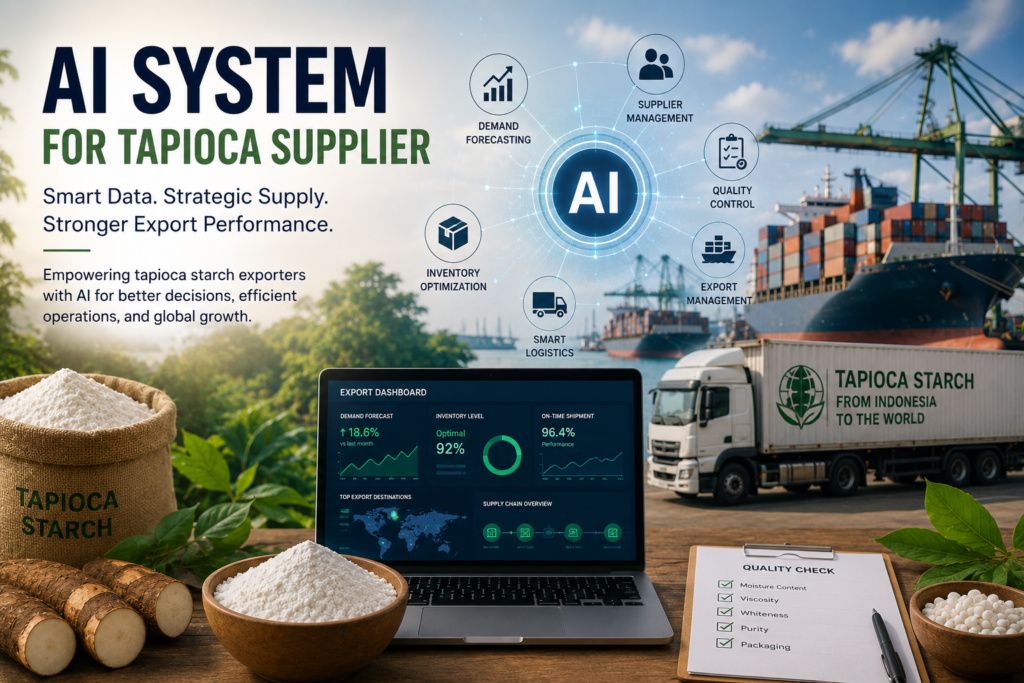
The global demand for tapioca starch continues to grow as manufacturers seek reliable ingredients for food processing, paper production, textiles, pharmaceuticals, and biodegradable products. As international markets become increasingly competitive, tapioca suppliers are expected to deliver consistent quality, stable pricing, and dependable shipping schedules. Meeting these expectations requires more than production capacity alone. Exporters must coordinate raw material sourcing, inventory management, quality inspection, logistics, customer communication, and international trade documentation. When these activities are handled manually, businesses often face delays, forecasting errors, and unnecessary operational costs. An AI system for tapioca supplier businesses offers a practical way to improve operational efficiency without changing the core principles of the industry. Artificial intelligence can analyze large volumes of data, automate repetitive administrative work, and provide valuable insights that support faster and more accurate business decisions.
Rather than replacing experienced supply chain professionals, AI strengthens decision-making across production, exports, and strategic supplier management. As digital transformation accelerates across international trade, companies that adopt AI are likely to become more competitive in both regional and global markets.
Why AI Is Becoming Important for Tapioca Export Businesses
Exporting tapioca starch involves a complex network of suppliers, manufacturers, warehouses, logistics providers, shipping companies, customs authorities, and international buyers.
Every stage produces operational data that can be used to improve planning. However, manually processing thousands of transactions, inventory records, purchase orders, and shipping documents becomes increasingly difficult as business grows.
Artificial intelligence helps organize and analyze this information in real time.
Instead of waiting for problems to appear, businesses gain early insights into inventory shortages, shipment delays, changing customer demand, and production requirements. This proactive approach allows exporters to respond faster while maintaining reliable service.
AI Improves Demand Forecasting for Export Markets
One of the biggest challenges facing tapioca exporters is predicting future demand. International buyers often adjust purchasing volumes based on seasonal production, economic conditions, food manufacturing trends, and exchange rates. Overestimating demand may increase storage costs, while underestimating demand can result in missed sales opportunities. AI system for tapioca supplier evaluate multiple variables simultaneously, including:
- Historical export volumes
- Customer purchasing patterns
- Seasonal demand
- Market price trends
- Production capacity
- Currency fluctuations
- Shipping schedules
Instead of relying only on previous sales reports, AI continuously updates forecasts as new information becomes available. This helps suppliers maintain healthier inventory levels while reducing unnecessary storage expenses.
Smarter Inventory Management
Inventory management plays an important role in maintaining smooth export operations. Although tapioca starch generally has a longer shelf life than fresh agricultural products, excessive storage still increases warehouse costs and ties up working capital.
AI helps businesses monitor inventory across multiple warehouse locations while identifying products that should be prioritized for shipment. The system can also recommend optimal stock levels based on customer demand and production schedules. As a result, warehouse space is used more efficiently, and inventory turnover becomes more predictable.
Supporting Better Strategic Supplier Management
Reliable raw material suppliers remain one of the most valuable assets for tapioca exporters. AI systems help evaluate supplier performance by analyzing:
| Supplier Performance Indicator | AI Analysis |
|---|---|
| Delivery consistency | Measures on-time delivery performance |
| Product quality | Detects recurring quality variations |
| Pricing trends | Monitors long-term purchasing costs |
| Production capacity | Estimates future supply capability |
| Contract performance | Identifies fulfillment reliability |
| Risk assessment | Detects potential supply disruptions |
Instead of relying solely on manual evaluations, procurement teams receive objective data that supports supplier selection and long-term partnerships.
This creates stronger collaboration throughout the supply chain while reducing procurement risks.
AI Enhances Product Quality Control
Maintaining consistent product quality is essential in export markets. International buyers often require strict compliance with moisture content, purity standards, packaging specifications, and food safety regulations. Modern AI systems can assist quality control teams by analyzing inspection records and identifying patterns that may indicate production inconsistencies. When integrated with automated inspection equipment, AI helps detect potential quality issues much earlier than traditional manual reviews.
Early detection minimizes rejected shipments while strengthening customer confidence.
Better Export Planning Through Data Analysis
Export operations involve numerous administrative processes, including shipping schedules, customs documentation, invoices, certificates of origin, and product specifications. AI simplifies many of these activities by organizing information, identifying missing documentation, and helping logistics teams prioritize urgent shipments.
When export managers have access to real-time operational data, they can coordinate production and shipping more effectively while minimizing unnecessary delays.
This improves overall customer satisfaction, particularly for international buyers with strict delivery deadlines.
AI and Logistics Work Together
Transportation remains one of the most important factors influencing export performance. Artificial intelligence analyzes various logistics variables, including:
- Shipping schedules
- Port congestion
- Delivery timelines
- Transportation costs
- Weather conditions
- Container availability
These insights help logistics teams make informed decisions before disruptions affect customer deliveries. Companies investing in AI in cold storage logistics demonstrate how intelligent monitoring systems improve operational visibility throughout temperature-controlled supply chains. Although tapioca starch does not typically require refrigerated transportation, many logistics principles—such as shipment tracking, predictive maintenance, and real-time monitoring—can also strengthen dry cargo export operations.
AI Supports Sustainable Export Operations
Sustainability has become an increasingly important consideration for global buyers. Many international companies prefer suppliers that reduce waste, improve operational efficiency, and manage resources responsibly. AI contributes by helping businesses:
- Reduce unnecessary inventory
- Improve warehouse utilization
- Optimize transportation routes
- Lower fuel consumption
- Minimize production waste
- Improve energy efficiency
These improvements support both profitability and environmental responsibility.
Practical Applications for Tapioca Suppliers
Businesses do not need to implement every AI solution at once. A company such as Agroloka Indo Varian can begin with demand forecasting and inventory optimization before expanding into supplier analytics, logistics monitoring, or predictive production planning.
This gradual approach allows management teams to measure performance improvements while minimizing implementation risks.
As cloud-based AI solutions become more affordable, medium-sized exporters can adopt advanced technologies without making major infrastructure investments.
AI Creates Opportunities Across Different Industries
The advantages of artificial intelligence extend beyond agricultural exports.
Businesses managing international logistics increasingly rely on AI driven supply chain solutions to improve forecasting, inventory planning, transportation efficiency, and supplier collaboration.
Similarly, sectors outside manufacturing continue integrating intelligent technologies into daily operations. The growing interest in future AI in hospitality reflects how businesses use artificial intelligence to improve customer experiences while streamlining internal processes.
Although hospitality and agricultural exports operate in different industries, both demonstrate how AI supports smarter planning, better resource allocation, and stronger operational performance.
Challenges Businesses Should Consider
Data Accuracy Is Essential
Artificial intelligence depends on reliable operational data.
If inventory records, supplier information, or production reports are inaccurate, AI recommendations may also become unreliable.
Maintaining high-quality business data remains a priority.
Employee Training Still Matters
AI provides valuable recommendations, but experienced employees continue making strategic business decisions.
Training staff to understand AI-generated insights ensures technology supports existing expertise rather than replacing it.
Investment Should Match Business Needs
Not every AI solution is necessary for every exporter.
Businesses should identify operational challenges first before selecting technologies that deliver measurable improvements.
Starting with forecasting or inventory management often provides the fastest return on investment.
The Future of AI for Tapioca Suppliers
Artificial intelligence will continue shaping agricultural exports over the coming years. Future developments are expected to include:
- Predictive production planning
- Automated export documentation
- AI-assisted procurement
- Real-time supplier performance monitoring
- Smart warehouse automation
- Enhanced demand forecasting
- End-to-end shipment visibility
As global competition increases, businesses that combine operational experience with intelligent technology will be better positioned to serve international customers efficiently and consistently.
Conclusion
The international tapioca industry depends on reliable suppliers, efficient logistics, consistent product quality, and accurate planning. An AI system for tapioca supplier businesses provides practical solutions that improve forecasting, inventory management, supplier evaluation, export coordination, and operational efficiency.
Rather than replacing experienced professionals, AI strengthens decision-making by transforming operational data into useful business insights. Exporters that embrace digital innovation while maintaining strong supplier relationships will be better prepared to compete in an increasingly demanding global marketplace.
Frequently Asked Questions (FAQ)
What is an AI system for tapioca supplier businesses?
It is the use of artificial intelligence to improve forecasting, inventory management, supplier evaluation, export planning, logistics coordination, and operational decision-making.
How does AI improve tapioca exports?
AI helps businesses predict demand, optimize inventory, streamline export documentation, monitor supplier performance, and improve logistics planning.
Can medium-sized exporters use AI?
Yes. Many AI platforms are cloud-based and scalable, making them accessible to medium-sized businesses without requiring significant infrastructure investments.
Why is supplier evaluation important?
Reliable suppliers help maintain consistent product quality, stable production schedules, and dependable deliveries, all of which strengthen long-term customer relationships.
Does AI replace export managers?
No. AI provides data-driven recommendations, while experienced managers continue making strategic decisions based on operational knowledge and market conditions.