

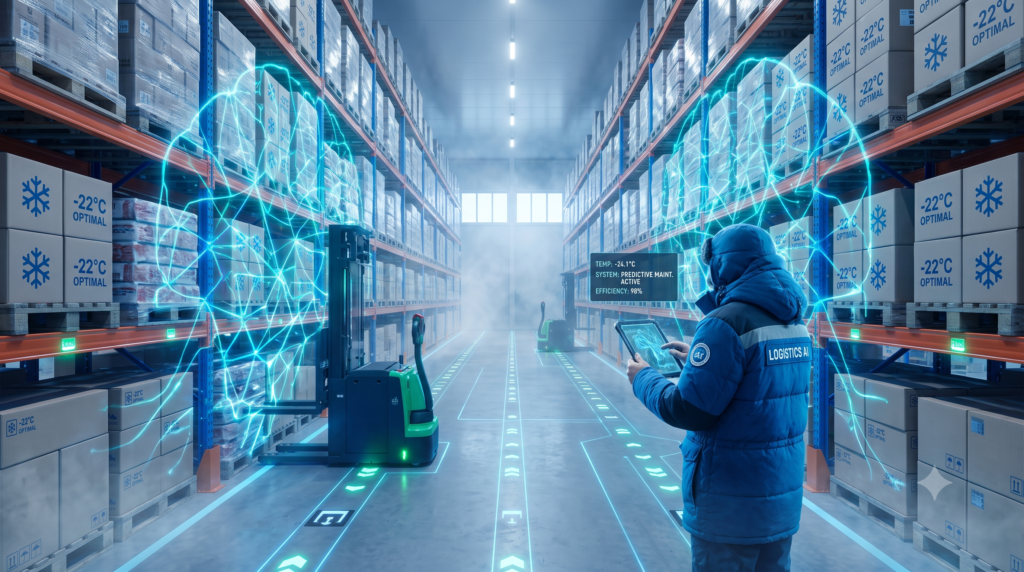
Running a massive freezing facility is a logistical nightmare. When a single degree of temperature change can ruin a massive shipment of frozen seafood, fresh produce, or vital pharmaceuticals, relying entirely on humans with clipboards is no longer a practical option. The logistics industry is under immense pressure to deliver goods faster while maintaining strict safety standards. To meet these demands, facility managers are turning to artificial intelligence (AI) in cold storage use.
Integrating AI in cold storage is not about replacing warehouse workers with robots. Rather, it focuses on predictive software, smart sensors, and automated data tracking. These invisible systems work constantly in the background to ensure that refrigeration units operate efficiently and that space is used in the smartest way possible. This technology helps businesses protect their inventory, lower their massive electricity bills, and guarantee that consumer goods remain safe from the moment they leave a farm to the moment they arrive at a kitchen.
Why Temperature Matters More Than Ever
Every year, global supply chains lose billions of dollars due to spoiled goods. The traditional method of maintaining cold chains involved manual checks, where workers would periodically walk through freezing rooms to read thermometers and log the numbers into a spreadsheet. If a cooling fan broke during the night shift, nobody would know until the morning, and by then, the damage was already done.
Shifting from Manual Checks to Automated Precision
Today, the integration of intelligent software fundamentally changes how facilities monitor their environment. Modern warehouses are fitted with thousands of digital sensors that constantly read humidity and temperature levels. Instead of just recording the current temperature, smart algorithms analyze the data in real-time. If a compressor starts vibrating slightly differently or a door seal begins to leak cold air, the system notices the tiny anomaly immediately.
The software can predict an equipment failure days before a human technician would ever hear a strange noise. It instantly sends an alert to the maintenance team, allowing them to fix the cooling unit before the temperature inside the chamber even has a chance to rise. This shift from reacting to a problem to preventing it entirely is the biggest advantage of modern warehouse technology.
Streamlining Physical Warehouse Operations
A cold room is not a comfortable place to work. Employees wear heavy insulated suits and drive forklifts through aisles kept well below freezing. Because of the harsh conditions, humans naturally move a bit slower, and mistakes can happen. Organizing thousands of pallets of identical boxes requires extreme precision.
The Impact on Local and Global Supply Chains
Advanced algorithms take over the heavy mathematical lifting of inventory management. When a new truckload of frozen goods arrives, the system calculates the exact optimal location for every single pallet based on its expiration date, weight, and how soon it needs to be shipped out again. In Indonesia, for instance, major facilities like Suri Nusantara Jaya Cold Storage handle vast amounts of chilled and frozen goods to support national food security. Managing such a massive volume of inventory safely requires sophisticated warehouse management systems that are highly responsive. By automating the tracking of what comes in and what goes out, facilities can ensure older products leave the warehouse first, drastically reducing the amount of expired food that ends up in a landfill.
Connecting the Dots: From Warehouse to Consumer
The benefits of a perfectly maintained cold chain do not stop at the loading dock. The downstream effects reach all the way to the end consumer. Restaurants, hotels, and grocery stores depend entirely on the reliability of their logistics partners.
Empowering the Food Service Industry
If a delivery of premium beef thaws during transit or storage, it completely ruins a chef’s menu planning for the weekend. By ensuring that supply lines are flawless, smart storage directly supports the growing trend of AI use in restaurant operations. Modern kitchen managers use predictive software to forecast exactly how many ingredients they need to order. They can only rely on those forecasts if they trust the warehouse to deliver the food in perfect condition.
This reliability cascades down the entire service sector. Flawless food and beverage logistics are a massive component of AI in hospitality, allowing high-end hotels, resorts, and cruise ships to guarantee fresh, safe, and premium dining experiences for their guests regardless of the season or location.
The Business Side of Things
Upgrading a traditional warehouse with smart sensors and predictive software is a massive financial investment. However, facility owners quickly see a return on that investment through energy savings alone. Industrial refrigeration consumes an incredible amount of electricity. Smart systems can adjust the cooling output based on the exact volume of goods inside a room or even align heavy freezing cycles with off-peak electricity hours to save money.
Promoting Better Logistics
Logistics providers that invest in this level of smart technology often use their low spoilage rates and high energy efficiency as a major selling point. By feeding their impressive success metrics and sustainability data into campaigns designed by AI for digital marketing, these warehouse operators can effectively attract new corporate clients. Brands want to partner with supply chains that are reliable, modern, and transparent.
Traditional vs. Smart Cold Storage Management
To understand the real-world difference, here is a comparison of how traditional facilities operate versus those utilizing modern smart systems.
| Operation Parameter | Traditional Cold Storage | AI-Powered Cold Storage |
| Temperature Tracking | Manual daily checks using physical thermometers. | 24/7 continuous digital monitoring with instant mobile alerts. |
| Equipment Maintenance | Fixing cooling units only after they completely break down. | Predictive maintenance that catches mechanical issues before they happen. |
| Inventory Placement | Operators deciding where to put pallets based on empty space. | Software calculating the most efficient placement based on shipping schedules. |
| Energy Consumption | Cooling units run at a constant, expensive rate all day. | Cooling cycles automatically adjust based on warehouse capacity and electricity rates. |
| Waste Reduction | High risk of spoilage due to human error and blind spots. | Near-zero spoilage due to automated expiration date tracking (FEFO). |
Frequently Asked Questions (FAQ)
1. What exactly does AI in cold storage do?
It primarily analyzes data from digital sensors to maintain perfect temperature control, predicts when refrigeration equipment might break down, and organizes inventory so that products are shipped out before they expire.
2. Does this technology help the environment?
Yes. Industrial freezers use a lot of electricity. Smart systems optimize when and how hard the cooling units run, which drastically lowers energy consumption. It also prevents massive amounts of spoiled food from being thrown away.
3. Is it expensive for a warehouse to install these smart systems?
The initial cost of installing digital sensors, upgrading warehouse management software, and training staff is significant. However, the long-term savings on electricity and the reduction in ruined inventory usually make up for the cost very quickly.
4. How does smart cold storage help local restaurants?
Restaurants rely on consistent, high-quality ingredients. If a cold storage facility uses smart tech to guarantee that fish or meat is kept at the perfect temperature, the restaurant receives fresher food, which leads to better meals for their customers.
5. Can these systems completely run a warehouse without humans?
No. The technology is designed to handle the complex data and constant monitoring, but human workers are still essential for physically operating heavy machinery, driving trucks, and managing the overall facility. The software simply makes their jobs safer and more efficient.