

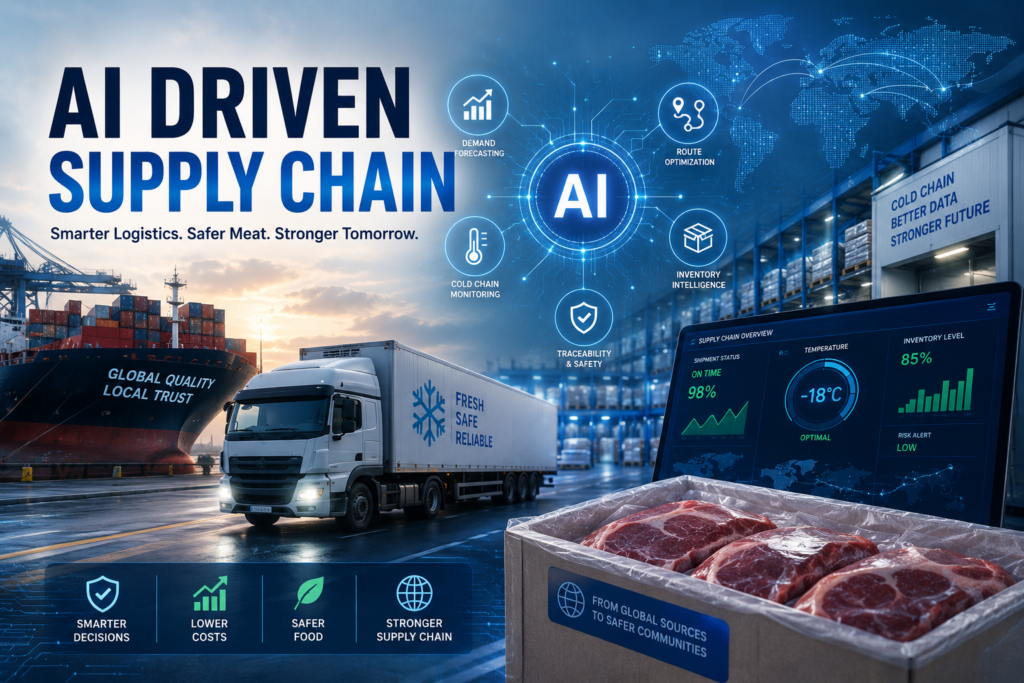
The global meat industry depends on an efficient supply chain to ensure products arrive safely, maintain quality, and meet consumer demand. Every stage, from overseas suppliers to local distributors and retailers, requires careful planning. Delays, temperature fluctuations, inaccurate demand forecasts, or inventory issues can quickly affect product quality and business performance. As the logistics sector becomes more complex, AI driven supply chain is emerging as a practical solution rather than a futuristic concept. Businesses are increasingly using AI to analyze large amounts of operational data, predict demand, optimize transportation routes, and monitor cold chain conditions in real time. These capabilities allow companies to make faster decisions while reducing waste and operational costs.
For businesses involved in imported meat distribution, an AI driven supply chain offers opportunities to improve efficiency without compromising food safety. Rather than replacing logistics professionals, AI supports them by providing accurate insights that simplify daily operations and reduce avoidable risks. This article explores how AI is changing imported meat logistics, the benefits it offers, and why it is becoming an essential investment for modern supply chain management.
Why AI Is Changing Modern Supply Chains
Supply chains have become increasingly data-driven. A single shipment of imported meat may involve overseas suppliers, shipping companies, customs authorities, cold storage facilities, transport providers, wholesalers, and retailers. Each stage generates valuable information that can help businesses make better decisions. However, manually processing this data is time-consuming and often leads to delays.
An AI-driven system analyzes operational data continuously and identifies patterns that people might overlook. Instead of reacting after problems occur, businesses can anticipate disruptions before they affect deliveries. For companies handling temperature-sensitive products such as imported beef or lamb, this proactive approach makes a significant difference.
How AI Improves Imported Meat Logistics
Demand Forecasting Becomes More Accurate
One of the biggest challenges in imported meat distribution is predicting market demand. Ordering too much inventory increases storage costs and raises the risk of expired products. Ordering too little may lead to shortages, disappointed customers, and lost revenue. AI forecasting models evaluate multiple factors simultaneously, including:
- Historical sales
- Seasonal demand
- Public holidays
- Restaurant purchasing trends
- Economic conditions
- Weather patterns
- Promotional campaigns
Rather than relying solely on previous sales figures, AI continuously updates forecasts as new information becomes available. This enables distributors to purchase inventory with greater confidence while reducing unnecessary stock accumulation.
Smarter Inventory Management
Managing inventory is especially challenging when products have limited shelf life. AI systems continuously monitor stock levels across warehouses and distribution centers. If certain products are moving more slowly than expected, the system can recommend transferring inventory to locations where demand is higher. Businesses also receive alerts before products approach expiration dates, allowing them to prioritize distribution and reduce food waste. This approach improves inventory turnover while supporting profitability.
Cold Chain Monitoring in Real Time
Temperature control is one of the most critical aspects of imported meat logistics. Even brief temperature fluctuations during transportation or storage can compromise food quality and safety. AI works together with Internet of Things (IoT) sensors to monitor refrigerated containers throughout the journey. If the system detects unusual temperature changes, logistics managers receive immediate notifications so corrective action can be taken before products are affected. Instead of discovering problems after deliveries arrive, businesses gain continuous visibility across the entire transportation process.
AI Supports Better Transportation Planning
Transportation delays affect both operational costs and customer satisfaction. Modern AI systems analyze:
- Traffic conditions
- Weather forecasts
- Port congestion
- Shipping schedules
- Fuel consumption
- Vehicle availability
Using this information, AI recommends more efficient delivery routes while adjusting schedules when unexpected disruptions occur. For imported meat distributors, maintaining delivery schedules helps preserve product quality and strengthens relationships with retailers and food service businesses.
Improving Traceability Across the Supply Chain
Consumers are increasingly interested in knowing where their food comes from. AI makes traceability easier by connecting information from suppliers, shipping documents, warehouse systems, and distribution records. When every movement is digitally recorded, businesses can quickly identify:
| Supply Chain Stage | AI Contribution |
|---|---|
| Overseas supplier | Tracks product origin and production records |
| International shipping | Monitors shipment status and estimated arrival |
| Customs clearance | Organizes documentation more efficiently |
| Cold storage | Monitors storage conditions continuously |
| Distribution | Tracks delivery performance and inventory movement |
| Retail delivery | Improves order accuracy and product availability |
Improved traceability also helps businesses respond more effectively if product recalls become necessary.
Reducing Operational Costs Without Sacrificing Quality
Many people assume AI is primarily designed to automate jobs. In reality, AI is often more valuable because it improves decision-making. For imported meat businesses, AI contributes to cost reduction by:
- Preventing unnecessary inventory purchases
- Reducing fuel consumption
- Optimizing warehouse operations
- Lowering spoilage rates
- Improving labor scheduling
- Detecting operational inefficiencies
Over time, these incremental improvements produce meaningful financial savings while maintaining high service standards.
AI and Sustainability in Meat Logistics
Sustainability has become an important priority throughout the food industry. Efficient logistics reduce environmental impact by minimizing waste and improving transportation efficiency. AI contributes to sustainability by:
- Reducing unnecessary transportation routes
- Lowering fuel consumption
- Minimizing food waste
- Improving warehouse energy usage
- Optimizing refrigeration systems
- Supporting more accurate purchasing decisions
Rather than focusing only on profitability, businesses can also improve their environmental performance through smarter logistics planning.
Practical Applications for Meat Import Companies
Companies involved in imported meat distribution can adopt AI gradually rather than transforming their entire operation at once. For example, Suri Nusantara Jaya may begin by implementing AI-powered demand forecasting before expanding into inventory optimization, predictive maintenance, or automated logistics reporting. This phased approach allows businesses to evaluate results while minimizing implementation risks. As AI technology becomes more accessible, even medium-sized distributors can benefit from tools that were previously available only to large multinational companies.
AI Creates Opportunities Beyond Logistics
The benefits of AI extend beyond transportation and warehousing. Restaurants, hotels, retailers, and food distributors all depend on reliable supply chains. Businesses exploring AI use in restaurant solutions often integrate purchasing forecasts with supplier inventory systems. When restaurant demand increases, distributors can respond more efficiently because inventory planning has already been optimized through AI.
Likewise, industries outside food distribution continue adopting intelligent technologies. The growing interest in future AI in hospitality demonstrates how artificial intelligence supports operational efficiency while improving customer experiences.
Similar innovations can also be seen in AI in hospitality, where businesses use predictive analytics, automation, and personalized services to strengthen day-to-day operations. Although these industries serve different markets, they share one common objective: using AI to support people, improve efficiency, and make better business decisions.
Challenges Businesses Should Consider
Despite its advantages, AI implementation requires careful planning.
Data Quality Matters
AI produces reliable recommendations only when businesses collect accurate operational data. Incomplete or outdated information reduces forecasting accuracy and limits the system’s effectiveness.
Staff Training Remains Essential
Technology alone cannot improve logistics. Employees need proper training to understand AI recommendations and combine them with practical experience. The strongest supply chains are those where human expertise and technology work together.
Cybersecurity Cannot Be Ignored
Supply chain systems contain valuable operational information. Businesses must invest in cybersecurity measures that protect customer records, supplier data, and operational systems from unauthorized access.
The Future of AI Driven Supply Chain Management
Artificial intelligence will continue reshaping logistics over the next decade. Future developments may include:
- Predictive maintenance for refrigerated vehicles
- Autonomous warehouse operations
- Smarter customs documentation
- AI-assisted procurement decisions
- Carbon footprint optimization
- More accurate demand forecasting
- End-to-end supply chain visibility
Rather than replacing experienced logistics professionals, these technologies will provide better information that supports faster and more informed decision-making. Businesses that adopt AI strategically will likely become more resilient, responsive, and competitive in an increasingly demanding global market.
Conclusion
The imported meat industry depends on precision, consistency, and reliable logistics. An AI driven supply chain provides businesses with the ability to forecast demand more accurately, monitor cold chain performance, optimize inventory, and improve transportation planning.
For importers, distributors, and food service suppliers, AI is no longer simply an emerging technology. It is becoming an essential tool for managing increasingly complex supply chains while maintaining food quality and operational efficiency. Organizations that combine human expertise with intelligent technology will be better prepared to meet changing customer expectations, strengthen sustainability efforts, and remain competitive in the years ahead.
Frequently Asked Questions (FAQ)
1. What is an AI driven supply chain?
An AI driven supply chain uses artificial intelligence to analyze operational data, improve forecasting, optimize logistics, and support faster business decisions across the supply chain.
2. How does AI improve imported meat logistics?
AI helps forecast demand, monitor cold chain temperatures, optimize transportation routes, improve inventory management, and increase supply chain visibility.
3. Why is cold chain monitoring important?
Maintaining consistent temperatures during storage and transportation helps preserve meat quality, supports food safety, and reduces spoilage.
4. Can small meat import companies use AI?
Yes. Many AI solutions are cloud-based and scalable, allowing small and medium-sized importers to adopt forecasting, inventory management, and logistics optimization tools without major infrastructure investments.
5. Does AI replace logistics professionals?
No. AI supports logistics teams by automating repetitive analysis and providing data-driven recommendations, while experienced professionals continue making strategic operational decisions.