

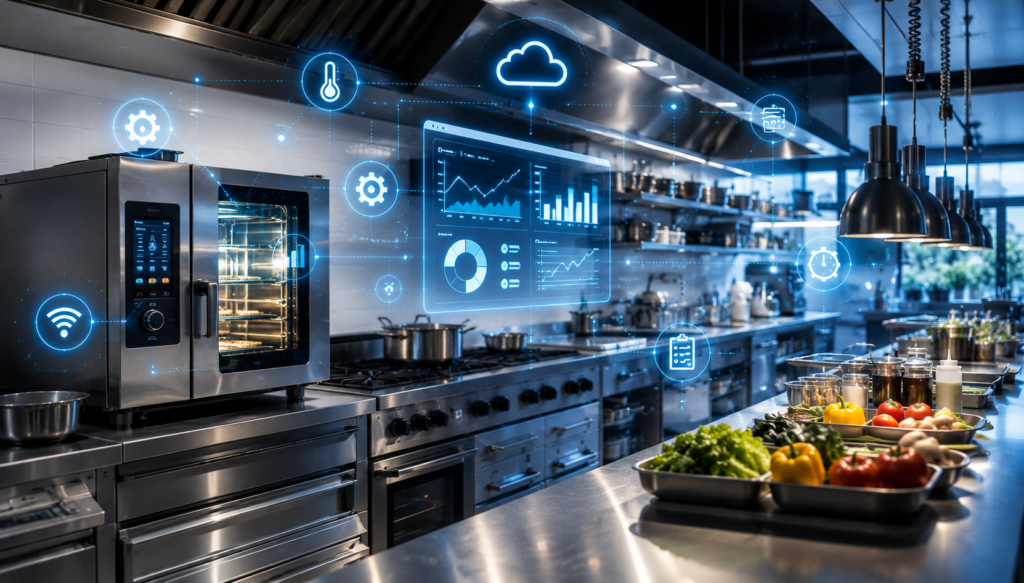
Commercial kitchens have evolved far beyond traditional cooking spaces. Restaurants, hotels, catering businesses, cloud kitchens, hospitals, and food manufacturers now rely on advanced equipment to deliver consistent quality while keeping operations efficient. As customer expectations continue to grow, kitchen operators are expected to prepare food faster, reduce waste, control operating costs, and maintain strict food safety standards.
Managing a commercial kitchen, however, involves much more than preparing meals. Businesses must monitor equipment performance, manage inventory, schedule maintenance, control energy consumption, and ensure every appliance operates efficiently. When these processes depend entirely on manual monitoring, the likelihood of equipment failures, unnecessary downtime, and inventory shortages increases.
Artificial intelligence is beginning to reshape how commercial kitchens operate. Rather than replacing chefs or kitchen staff, AI provides intelligent support that helps businesses make better operational decisions. By analyzing real-time data, predicting maintenance needs, and improving resource management, AI for commercial kitchen enables commercial kitchens to operate more efficiently while maintaining consistent service quality.
This article explores how AI for commercial kitchen solutions are transforming commercial cooking equipment and kitchen supplies, along with the opportunities and challenges businesses should consider as digital technologies continue to evolve.
Why AI Is Becoming More Important in Commercial Kitchens
Modern commercial kitchens operate under constant pressure. Orders arrive continuously, customer expectations remain high, and equipment must function reliably throughout the day. Even a single equipment failure can interrupt service, increase operating costs, and affect customer satisfaction.
Artificial intelligence helps kitchen operators manage these challenges by collecting and analyzing operational data from multiple sources. Instead of relying solely on manual inspections, AI identifies patterns that indicate when equipment requires maintenance, when inventory needs replenishment, or when energy consumption becomes unusually high.
This proactive approach allows businesses to solve potential problems before they affect daily operations.
AI Improves Equipment Performance
Predictive Maintenance Reduces Downtime
Commercial cooking equipment represents a significant investment for every food business.
Ovens, refrigerators, fryers, mixers, dishwashers, and food preparation machines require regular maintenance to remain reliable. Traditionally, maintenance takes place after equipment begins showing signs of failure or according to fixed schedules.
AI changes this approach through predictive maintenance.
By analyzing operating hours, temperature fluctuations, motor performance, and previous maintenance records, AI can estimate when a component is likely to require servicing.
Instead of waiting until equipment stops working, technicians receive early maintenance recommendations.
This reduces unexpected breakdowns, lowers repair costs, and extends equipment lifespan.
Real-Time Equipment Monitoring
Many modern appliances are equipped with sensors capable of transmitting operational information.
AI continuously monitors data such as:
- Operating temperature
- Power consumption
- Equipment usage frequency
- Cooling performance
- Motor efficiency
- Error notifications
When abnormal conditions are detected, the system immediately alerts operators before small issues develop into larger technical failures.
This allows maintenance teams to respond quickly while minimizing operational disruption.
Smarter Kitchen Supplies Management
Inventory management remains one of the most challenging aspects of running a commercial kitchen.
Ordering too many supplies increases storage costs and food waste, while insufficient inventory can delay service and reduce customer satisfaction.
AI analyzes purchasing history, seasonal demand, menu popularity, supplier delivery schedules, and sales trends to estimate future inventory requirements.
Rather than relying on manual calculations, businesses receive purchasing recommendations based on current operational data.
This supports more accurate procurement while improving inventory turnover.
AI Supports Better Purchasing Decisions
Commercial kitchens depend on reliable suppliers for cooking equipment, replacement parts, and kitchen supplies.
Artificial intelligence can evaluate supplier performance by analyzing measurable indicators.
| Supplier Evaluation | AI Contribution |
|---|---|
| Delivery reliability | Tracks on-time deliveries |
| Product quality | Reviews historical quality records |
| Price consistency | Compares purchasing trends |
| Equipment availability | Predicts supply shortages |
| Service responsiveness | Measures communication performance |
| Maintenance support | Tracks after-sales service quality |
This information helps procurement teams select suppliers based on long-term performance rather than short-term pricing alone.
Improving Energy Efficiency
Energy costs represent a substantial portion of commercial kitchen operating expenses.
Refrigeration systems, ovens, ventilation equipment, and dishwashing machines consume large amounts of electricity every day.
AI helps monitor energy usage by identifying equipment that consumes more power than expected.
The system may recommend adjusting operating schedules, performing maintenance, or replacing inefficient equipment.
Over time, these improvements reduce operating costs while supporting sustainability initiatives.
Better Food Safety and Compliance
Maintaining food safety requires continuous monitoring.
AI can assist by automatically recording equipment temperatures, refrigeration performance, cleaning schedules, and maintenance activities.
Instead of relying entirely on manual documentation, businesses maintain accurate digital records that simplify inspections and regulatory compliance.
Real-time alerts also help operators respond immediately if refrigeration temperatures exceed acceptable limits.
This minimizes product loss while protecting food quality.
Practical Applications for Commercial Equipment Suppliers
Businesses supplying commercial cooking equipment also benefit from AI.
For example, Petra Equipment can use AI to analyze customer purchasing patterns, forecast equipment demand, improve inventory planning, and schedule preventive maintenance for installed equipment.
Customer service also becomes more efficient because AI helps organize service histories, warranty information, and maintenance schedules.
Rather than responding only after customers report problems, suppliers can provide proactive support that strengthens long-term business relationships.
AI Creates Opportunities Across Related Industries
Artificial intelligence is transforming many sectors connected to commercial kitchens.
Restaurants increasingly rely on AI use in restaurant solutions to improve staffing, inventory management, customer service, and menu planning through data-driven decision-making.
Technical maintenance providers are also adopting AI for service technologies that improve predictive maintenance, technician scheduling, spare parts management, and customer support.
Similarly, the growing adoption of AI in hospitality demonstrates how hotels and accommodation providers use intelligent technologies to improve operational efficiency while delivering more personalized guest experiences.
Although each industry has different priorities, they all benefit from AI’s ability to reduce repetitive work, improve planning, and support better operational decisions.
Challenges Businesses Should Consider
Human Expertise Still Matters
Artificial intelligence can analyze operational data quickly, but it cannot replace experienced chefs, technicians, or kitchen managers.
Professionals continue making important decisions regarding food preparation, equipment selection, customer service, and operational strategy.
AI should be viewed as a decision-support tool rather than a substitute for skilled employees.
Data Quality Determines AI Accuracy
AI systems depend on accurate operational information.
If equipment records, inventory data, or maintenance histories are incomplete, recommendations may become less reliable.
Businesses should maintain organized and consistent data to achieve the best results.
Cybersecurity Should Not Be Overlooked
Commercial kitchens increasingly use connected equipment and cloud-based management systems.
Protecting operational data, supplier information, and maintenance records requires strong cybersecurity measures.
Businesses should ensure that AI platforms follow recognized security standards to reduce digital risks.
The Future of AI for Commercial Kitchens
Artificial intelligence will continue influencing commercial kitchens over the coming years.
Future developments are expected to include:
- AI-assisted cooking equipment diagnostics
- Predictive maintenance scheduling
- Automated inventory forecasting
- Smart procurement recommendations
- Energy optimization systems
- Remote equipment monitoring
- AI-powered operational analytics
As these technologies become more affordable, businesses of all sizes will have greater opportunities to improve efficiency without compromising food quality or customer service.
The most successful commercial kitchens will not rely entirely on automation. Instead, they will combine experienced professionals with intelligent technology to create more reliable and efficient operations.
Conclusion
The adoption of AI for commercial kitchen solutions is reshaping how businesses manage cooking equipment, kitchen supplies, maintenance, and daily operations. By improving equipment monitoring, inventory management, purchasing decisions, and preventive maintenance, AI helps businesses operate more efficiently while reducing unnecessary costs.
For equipment suppliers, restaurant operators, hotels, and food service providers, artificial intelligence should be viewed as a practical business tool that strengthens operational performance rather than replacing experienced professionals. Businesses that embrace AI strategically while maintaining strong operational expertise will be better prepared to meet the changing demands of the food service industry.
Frequently Asked Questions (FAQ)
1. What is AI for commercial kitchen?
AI for commercial kitchen refers to the use of artificial intelligence to improve equipment monitoring, inventory management, maintenance scheduling, purchasing decisions, and overall kitchen operations.
2. How does AI improve commercial cooking equipment?
AI monitors equipment performance, predicts maintenance needs, detects abnormal operating conditions, and helps reduce unexpected equipment failures.
3. Can AI help manage kitchen supplies?
Yes. AI analyzes purchasing history, inventory levels, supplier performance, and sales trends to recommend more accurate purchasing decisions and inventory planning.
4. Is AI suitable for small commercial kitchens?
Yes. Many cloud-based AI platforms are scalable and can be implemented gradually, making them suitable for both small businesses and large commercial kitchens.
5. Will AI replace chefs or kitchen staff?
No. AI supports kitchen operations by automating repetitive monitoring and administrative tasks, while chefs and kitchen professionals remain responsible for food preparation, creativity, and operational decision-making.